Intellectual Property

First AI copyright infringement settlements – both within a week: Anthropic and Eleven Labs avoid risking billion-dollar valuations.

2025-09-12T13:27:05-04:00August 28th, 2025|Artificial Intelligence, Contracts, Copyright, Intellectual Property, Licensing|

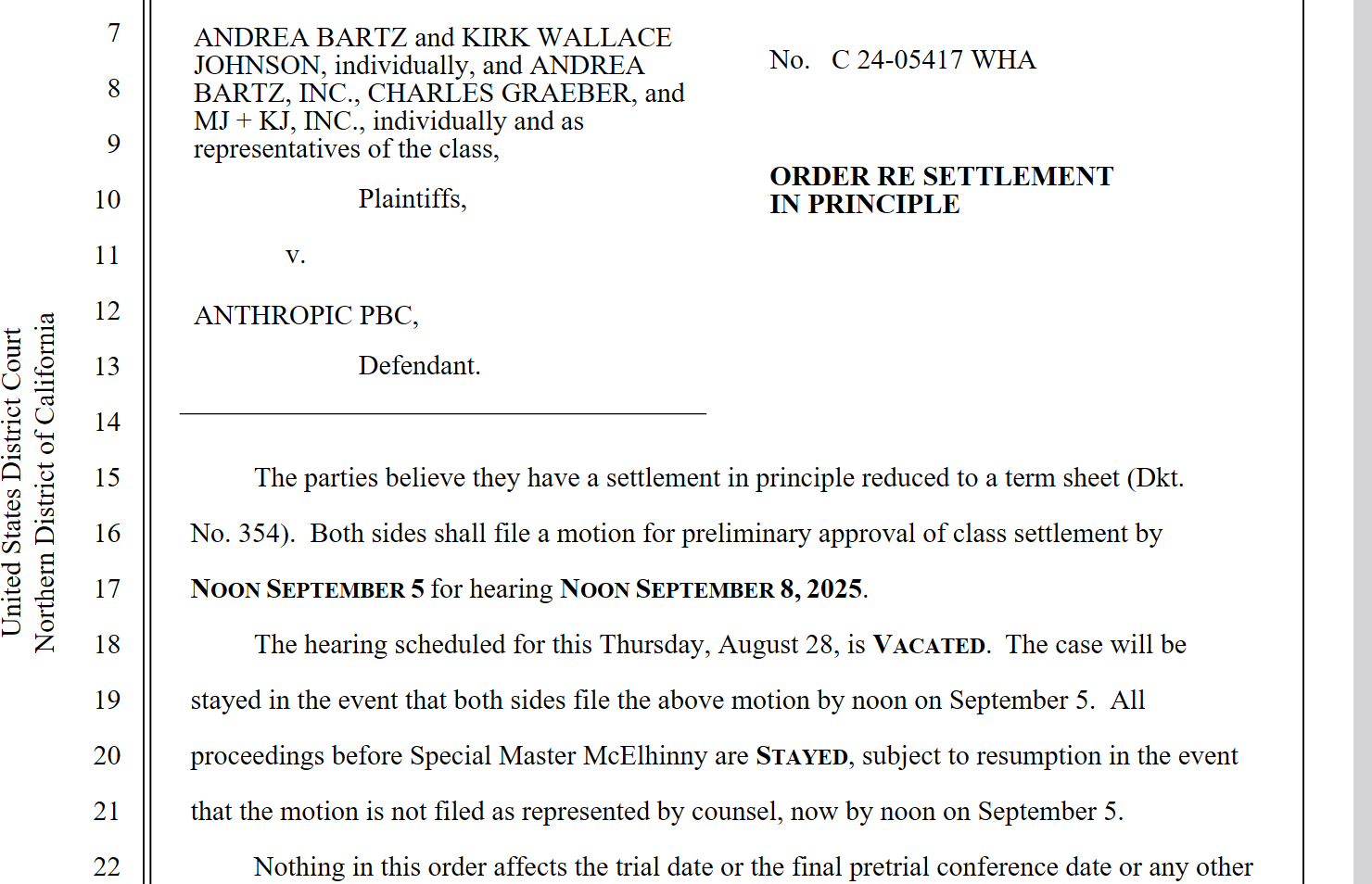
Big news: Vacker v. Eleven Labs and Bartz v. Anthropic have settled. Why did they settle, and what does this mean for the other 46 AI copyright infringement cases currently pending? Vacker v. Eleven Labs: Aug. 20th Stipulation to Stay Proceedings Bartz v. Anthropic: Aug. 26th Order re: Settlement in Principle First, there are a few common themes: The alleged copyright infringement was blatant and intentional The companies faced both reputational and financial harm Both were raising money based on valuations of billions of dollars Their losses could potentially damage or destroy the business model (some companies training on everything, [...Read More...]
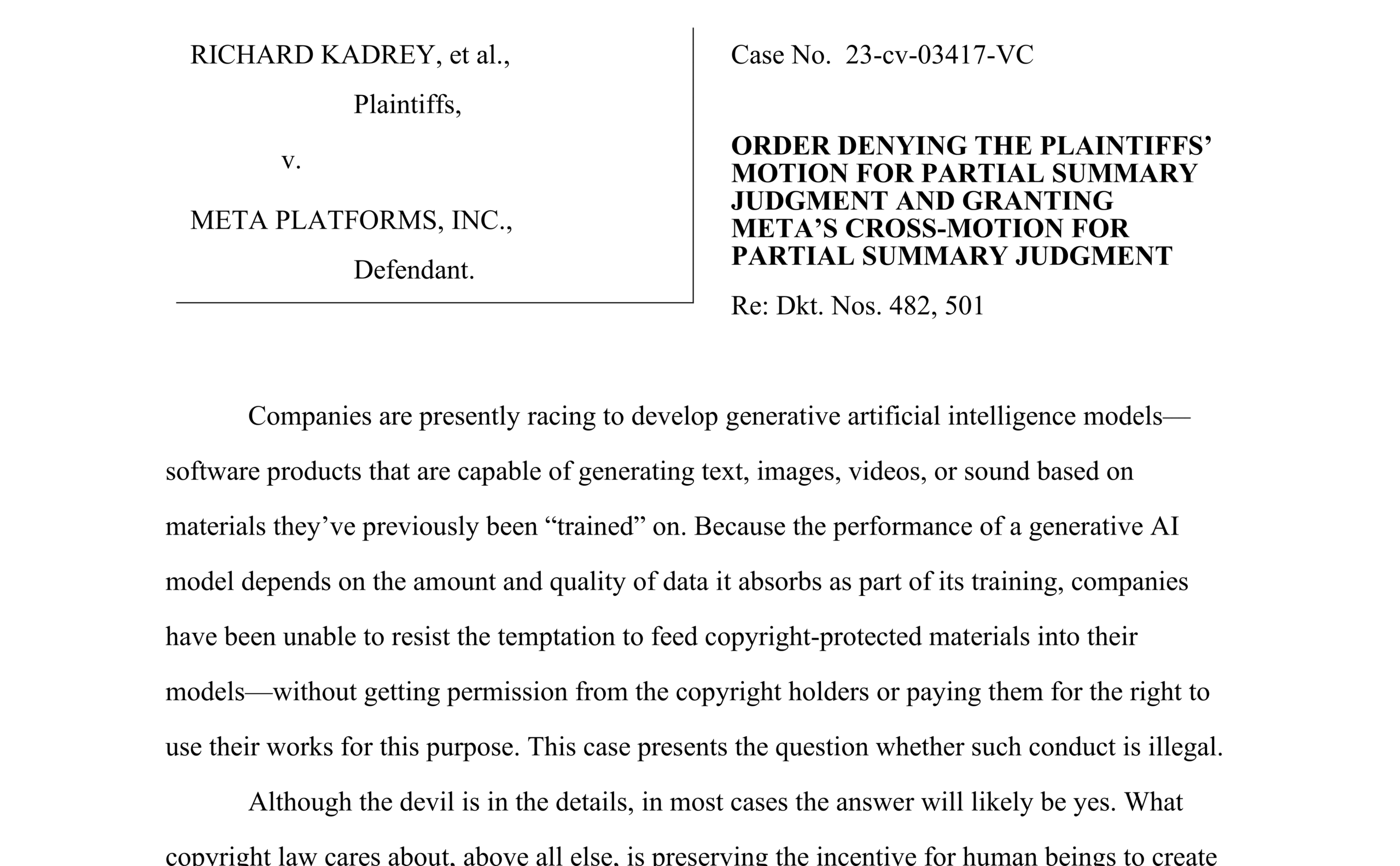
Judge: Meta Wins but Transformative Element of Fair Use Doesn’t Outweigh Market Impact

2025-09-12T13:38:54-04:00June 26th, 2025|Artificial Intelligence, Contracts, Copyright, Intellectual Property, Licensing|

"Every battle is won before it is ever fought." - Sun Tzu. Meta just won an early skirmish in the battle over whether AI training is fair use - but AI companies may end up losing overall if they focus on only the transformative element of copyright law's fair use test without addressing the market impact. Judge Chhabria's June 25, 2025 Order in Kadrey v. Meta Yesterday, in Kadrey v. Meta, Judge Chhabria granted Meta summary judgment, and said that even if training AI models on copyrighted works is transformative - "As a factual matter, there’s no disputing [...Read More...]

This is Not Mocha Mousse

2025-09-12T12:25:30-04:00April 18th, 2025|Intellectual Property, Licensing|

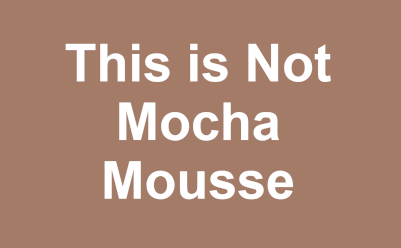
This is definitely not Mocha Mousse (Pantone 17-1230) The color you’re seeing in this image may look like Pantone’s 2025 Color of the Year, Mocha Mousse. It might even share the same hexadecimal value, straight from Pantone’s official Connect platform. But it’s not Mocha Mousse. Why not? Because unless you’ve licensed Pantone’s color system, or are using tools that have, you can’t officially use that color in design work. And for businesses, that distinction matters. Wait, What Is Mocha Mousse? Every year, Pantone selects a Color of the Year that captures the cultural moment. In 2024, it was [...Read More...]

Congratulations to Josh Waterston and Lewis Sorokin on receiving the Artificial Intelligence Governance Professional certification

2025-09-12T12:20:20-04:00October 23rd, 2024|Artificial Intelligence, Intellectual Property|

Wilftek is pleased to announce that Josh Waterston and Lewis Sorokin have each earned Artificial Intelligence Governance Professional certifications from the International Association of Privacy Professionals (IAPP). AI governance professionals are tasked with the critical responsibility of evaluating AI, integrating relevant standards and best practices, and developing and implementing strategies for compliance with applicable laws and regulations. With the global expansion of AI technology, there is a rapid, cross-industry need for these professionals to understand and execute AI governance in a safe and responsible manner. At Wilftek, we help our clients create new businesses, move forward with business opportunities, and [...Read More...]

USPTO AI Guidance for Lawyers: You can use AI – but don’t blame it for your mistakes.

2025-09-12T12:35:05-04:00May 17th, 2024|Artificial Intelligence, Intellectual Property|

Today, the USPTO issued its new guidance on using AI. This is for lawyers and others who practice before the patent and trademark office, and builds upon its internal guidance from this past February. The document is "Guidance on Use of Artificial Intelligence-Based Tools in Practice Before the United States Patent and Trademark Office", released this morning (Press release here / draft Federal Register notice here), and is similar to its internal guidance to the PTAB and TTAB on February 6th. The guidance (especially Section III) clarifies to practitioners that: Existing rules still apply (candor, good faith, review and certification of submissions, confidentiality, etc.).  [...Read More...]

The King is Dead – Long Live the King

2024-02-20T14:41:19-05:00February 8th, 2024|Intellectual Property|

What happens when you depend on a platform or device and the company behind it moves on without you? Google is retiring the Bard name and releasing Gemini as both a chatbot and successor to Assistant, which it has used for its smartphones and smart home speakers. Coincidentally, it has begun deprecating certain features built in to Assistant, which is probably upsetting anyone with an old device. As someone who has experienced smart devices being left in the dust as companies continue their onward march into the future, I recommend against buying into one company's platform, since you'll end [...Read More...]

Copying Technical Standards Referenced in Laws Held to Be Fair Use by D.C. Court of Appeals

2024-02-27T18:19:54-05:00September 25th, 2023|Copyright, Intellectual Property|

In American Society for Testing and Materials (ASTM) v. Public.Resource.Org, Inc., the D.C. Court of Appeals held on Sept. 12, 2023 that "Public Resource’s copying of material [217 industry standards] incorporated by reference into law, for free dissemination to the public, was fair use." This is likely not the last word on this subject*: the case began in 2013, was appealed, then stayed pending the Supreme Court's decision in the 2020 case of Georgia v. Public.Resource.Org (which held that annotated versions of state laws were not restricted by copyright). (h/t Fred Wilf) "Public  Resource  posts standards  that  government  agencies have incorporated into law [...Read More...]

Not So Happy Together – The Turtles vs. SiriusXM Copyright Case

2022-05-13T14:11:49-04:00August 31st, 2021|Contracts, Copyright, Intellectual Property|

What happens when Congress is unable - for almost 50 years - to figure out how to protect recorded music? Specifically, music recorded before 1972? Messy litigation involving the Turtles is what happens. First, some background. Almost 50 years ago, Congress passed the Sound Recording Amendment to the 1909 Copyright Act, which provided copyright protection to sound recordings created on or after February 15, 1972. However, there was no Federal law requiring that royalties be paid for works created before that date until Congress unanimously passed the Music Modernization Act in 2018. This law included a provision that required digital [...Read More...]

The Washington Football Team vs. Trademark Squatters – The Sequel

2021-08-04T23:38:18-04:00July 30th, 2021|Intellectual Property, Trademark|

On July 13, 2020, the era of the NFL's Washington Redskins ended (following pressure from the public and from corporate sponsors) and a new era began. Unfortunately, it was - and remains - an unnamed era. The team currently is called "The Washington Football Team" - it's better than "The Washington Insert Name Here" but not by much. Why the delay in getting a new name? Part of it could be related to the issues discussed in our article a year ago. Over the years, trademark applications have been filed for dozens of potential replacement team names. To protect its [...Read More...]

Supreme Court Fights Abuses of the Computer Fraud & Abuse Act

2022-06-28T15:03:21-04:00June 29th, 2021|Contracts, Intellectual Property, Privacy, Trade Secrets|

For 35 years, the Computer Fraud and Abuse Act (CFAA) has been a powerful weapon in law enforcement's arsenal against computer hackers. Essentially, it criminalized the standard definition of hacking - accessing information on a computer, where the user lacks authorization to do so. But what happens when someone is authorized to access the information, but then misuses the information? For example, a police officer who accepted a bribe and then accessed a vehicle database for non-law-enforcement purposes? This was the situation in Van Buren v. United States, which was decided by the U.S. Supreme Court on June 3, 2021. [...Read More...]

Go to Top